Language
中文English
Product SearchSearch
Try searching again

Search results for

alt
No Results Found

Please try a different search term

Zhen Ding Tech. Group

SUSTAINABLE MANUFACTURING

Promote Low-carbon and High-efficiency Production

In accordance with the initiative to control global warming by 1.5°C, combined with the requirements of local governments and our company's sustainable development strategy, Zhen Ding has formulated climate change management strategies and green development goals, and actively promoted low-carbon, high-efficiency and cleaner production activities.

The total investment in 2024 is NT$1,825 million, including NT$54.9 million in direct environmental load reduction investment, NT$129.0 million in indirect environmental load reduction investment, NT$213. 8 million in environmental investment to combat climate change, and environmental protection operating expenses NT$1,427.0 million.

Implementation Effectiveness

The 2024 energy conservation and carbon reduction project will achieve an annual carbon reduction of approximately 579,761 tons. Important investment in energy conservation projects include:

(1) Equipment efficiency improvement:
The newly constructed plants utilize motors with an IE4 rating or higher and level 1 energy efficiency. Compared to IE3 motors, these can achieve energy savings of over 10%, resulting in an annual carbon reduction of approximately 6,829 metric tons.

(2) System energy-saving adjustment:
FFU optimizes carbon reduction by 1,824 metric tons.

(3) Heat energy recovery and reuse:
Through the water source heat pump, the heat can be recycled from the air compressor and ice machine, replacing the heat needed to create steam for the production water intake and air conditioning unit. The heat recycling can reduce the natural gas use of the boilers and carbon emissions. The annual carbon reduction amounts to around 3,966 metric tons.

(4)Other miscellaneous energy conservation projects resulted in a total carbon reduction of 13,575 metric tons.

(5) Self-installed solar power generation:
• The installed solar energy capacity of Huai'an Campus I is 2.1 MW (self-generation for self-use).
• The installed solar energy capacity of Huai'an Manufacturing Campus II is 2.4 MW (self-generation for self-use).
• The installed solar energy capacity of Shenzhen Campus is 0.57 MW (self-generation for self-use).
Carbon reduction reaches 3,230 metric tons/year

(6) External purchasing green power:
External purchase green electricity and use green electricity to reduce greenhouse gas emissions. Carbon reduction is 550,337 metric tons/year

Facilitate the Utilization of Recycled Metals

Zhen Ding Technology primarily utilizes gold (Au), palladium (Pd), and tin (Sn) as its key rare metals. The materials involved encompass potassium gold cyanide, palladium salt or palladium salt solution, copper powder, copper balls, copper foil, solder paste, and solder balls. Given the scarcity of rare metal resources and their environmental impacts, not only is the entire industry actively striving to identify alternative materials, but Zhen Ding Technology also collaborates closely with its suppliers to closely monitor relevant technology application trends. Considering quality requirements and the current level of technological development, it is challenging to discover other viable alternative metals in the short term. However, to enhance sourcing diversity and ensure a stable supply, Zhen Ding Technology continues to collaborate with suppliers and customers to jointly promote the utilization of recycled metals. It actively advocates for raw material recycling to minimize resource consumption and supply risks.

Furthermore, through collaboration with customers and suppliers, Zhen Ding promotes the use of recycled metal raw materials that bear third - party certifications, such as ISO 14021 or UL 2809. Simultaneously, it advances technology optimization and material substitution strategies to achieve a balance between product quality and environmental sustainability.

Implementation Effectiveness

Zhen Ding has implemented a variety of recycling and reuse measures at the end - stage of the production process, encompassing metal recycling, packaging material reuse, and the development of innovative recycling technologies. The implementation status of each business unit is systematically tracked through the setting of annual targets and the application of percentage - based management. The reuse measures implemented in production in 2024 are as follows:

Gold (Au)

• The Group's annual utilization rate of recycled potassium gold cyanide reached 71%, with a target of achieving 90% by 2025.

• With the exception of the substrate business unit, all other business units utilized 100% recycled potassium gold cyanide in 2024.

• The total volume of recycled gold was approximately 330 kg, accounting for approximately 41% of the total gold consumption.

Copper (Cu)

• The supply sources for recycled copper foil have expanded from a single major supplier to the top three suppliers, and the annual utilization rate of recycled copper foil has exceeded 90%.

• The utilization rates of recycled copper powder and copper balls reached 84% and 98% respectively. With the exception of the substrate business unit, all other business units fully adopted recycled copper materials in the third quarter of 2024.

• 77% of CCL (Chemical Copper Cladding) uses recycled copper; FCCL (Fused Copper Cladding) materials have been undergoing testing with recycled rolled copper foil since 2023, and some products entered mass production in 2024.

• The total annual copper recycling volumewas approximately 5,401 tons, accounting for 81% of the total copper consumption; an additional 810 tons of recycled copper were used for the remanufacturing of copper foil.

Innovative Recycling Technologies

• The "Copper Carbonate Waste Conversion Project" was launched in 2024, successfully transforming copper carbonate waste into high - purity electronic - grade copper oxide, which can be directly reused in the production process. Approximately 977 tons of copper were recycled throughout the year.

• Continuous investment has been made in electrolysis equipment to recover precious metals from gold - containing waste liquid, achieving a closed - loop recycling process.

Tin (Sn)

• 88% of the solder paste used was recycled. Process improvements have increased the waste reuse rate and reduced resource wastage.

Palladium (Pd)

• Approximately 67 kg of palladium was recycled throughout the year, accounting for 36% of the total usage. Zhen Ding continues to collaborate with suppliers to expand recycling applications.

Other Recycling Measures

• By 2024, the proportion of recycled steel will increase to 30%, with 80% of each steel sheet containing recycled materials, demonstrating the success of recycling manufacturing auxiliary materials.

• In addition to metal materials, Zhen Ding is also promoting a packaging tray recycling and reuse program. It is working with clients to r ecycle and reuse packaging materials to reduce resource consumption. The packaging tray recycling rate will reach 8% in 2024, and the target for 2025 is 15%.

Source Reduction and Recycling

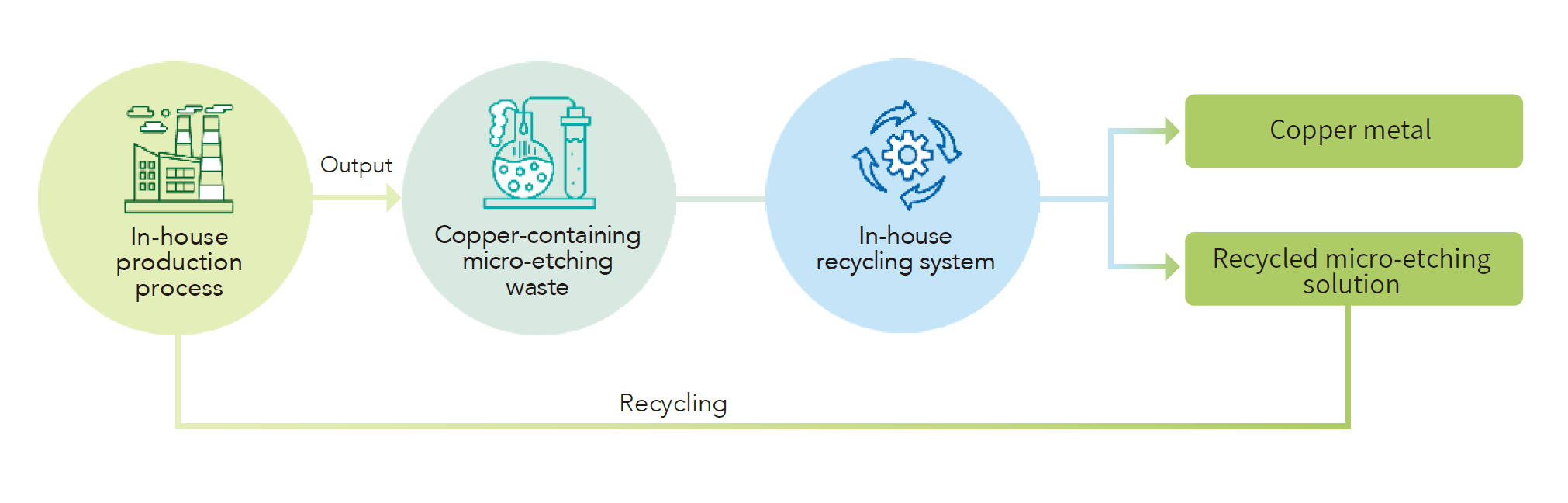
Best Case : Copper-containing Micro-etching Circulation

The copper-containing micro-etching waste is processed by the in-plant recycling system to recover copper metal and recycle micro-etching solution. The copper metal can be recycled, and the micro-etching solution is reused in the manufacturing process to achieve the effect of reducing both hazardous waste and raw materials.

Previous
Industrial Safety Concept and Culture

Industrial Safety Concept and Culture

Next
Safety production management

Safety production management

We have set up a safety production management organization, formulate company safety strategies and policies, implement laws and regulations, and conduct risk analysis and hidden danger management for company production operations.
1) Safety management organization: The company sets up a safety management organization and allocates full-time safety management personnel. At the same time, each factory is equipped with factory safety personnel, and each workshop is equipped with industrial safety officers as part-time safety management personnel to assist in various safety hazard self-examinations and hidden hazard reports . The company has established a safety production committee and regularly holds meetings to review safety work.
2) Enforcement of laws and regulations: The company's various new construction/reconstruction/expansion projects are carried out in strict accordance with occupational hazards, safety three simultaneous (simultaneous design, simultaneous construction, and simultaneous use) and other relevant national safety laws and regulations.
3) Hidden hazard management: The company always pays attention to the investigation and rectification of potential safety hazards, and adopts daily audits, joint audits, special audits, etc., to classify and manage plants according to risk levels. The company carries out special inspection projects such as "prevention of extreme summer weather" and "overwintering plan" in order to eliminate hidden dangers in time and prevent them before they happen.
4) System E-based management: The company establishes an EMS equipment management system and an industrial safety net system, and uses the Internet to implement equipment spot inspection, maintenance monitoring, and tracking of hidden dangers. The company promotes PAD paperless safety inspections to achieve time-limited, location-limited, and limited-person management, and improve the efficiency of inspections. Since 2017, PAD verification of high-risk equipment has been fully implemented. The company establishes a manufacturer's construction management platform to control the company's manufacturer activities and record the construction process.
5) Our company focuses on controlling risks from the source. All equipment, tools and instruments purchased must have safety protection measures. We evaluate processes with occupational hazards, set up ventilation, airtightness and noise reduction measures at the source, and regularly inspect and maintain facilities and detect and improve hazardous factors.